
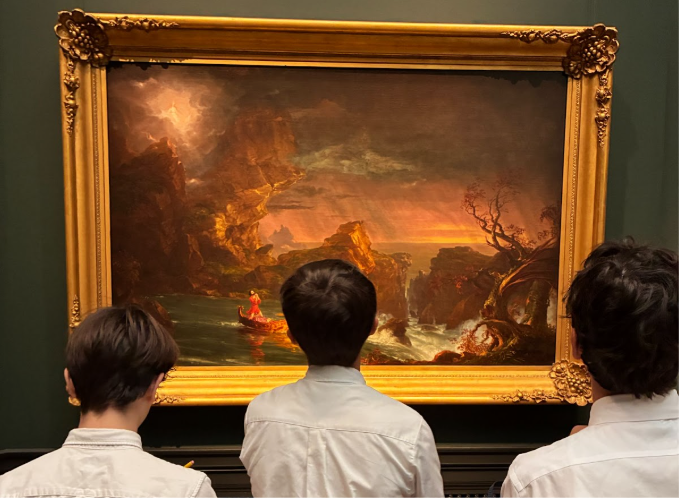
The Shock of Beauty
In our Sophomore Art History class, we began our semester by reading Pope Benedict XVI’s “Letter to Artists” to introduce some of the themes for the class. When reading the letter, I was struck by the fact that Pope Benedict begins his reflection on beauty by reflecting on the crisis of loneliness and the “increasing signs of resignation, aggression, and despair” that have arisen in contemporary culture.
For Benedict, beauty is a critical antidote and remedy to this crisis. Benedict writes, “An essential function of genuine beauty, as emphasized by Plato, is that it gives man a healthy shock, it draws him out of himself, wrenches him away from resignation and from being content with the humdrum—it even makes him suffer, piercing him like a dart, but in so doing it ‘reawakens’ him, opening afresh the eyes of his heart and mind, giving him wings and carrying him aloft.”
The encounter with beauty does not, as we see here, come without difficulty and pain. Beauty challenges us and calls us to live a higher form of life. Who has not heard a beautiful piece of music, a painting, a poem, a natural object, and felt, at the very same time, that this beauty demands a reformation of life? The German poet, Rainer Marie Rilke captures the challenge of beauty in his poem, The Archaic Torso of Apollo
We cannot know his legendary head
with eyes like ripening fruit. And yet his torso
is still suffused with brilliance from inside,
like a lamp, in which his gaze, now turned to low,
gleams in all its power. Otherwise
the curved breast could not dazzle you so, nor could
a smile run through the placid hips and thighs
to that dark center where procreation flared.
Otherwise this stone would seem defaced
beneath the translucent cascade of the shoulders
and would not glisten like a wild beast’s fur:
would not, from all the borders of itself,
burst like a star: for here there is no place
that does not see you. You must change your life.
The last line is, “you must change your life” reflects Benedict’s view that the encounter with real beauty–in this case the torso of a sculpture of Apollo–does not leave us unchanged. The fact of beauty demands a change of life.
This is one of the reasons that, at SJI, we place such an emphasis on beauty in our surroundings and our curriculum. It is not because we desire an effete aestheticism that uses beauty as a sign of power and dominance. Instead, we want to be transformed by the beautiful, made better by our encounter with the splendor of truth, and so strive to become more capable of a real union with Christ and, through Him, with our fellow man.


.jpg)